When to build software vs buy, now AI agents write code
For twenty years the safe answer to build or buy was buy. AI agents have changed the cost of running software, and with it where the line sits.
By Gary Kellett6 min read
For directors and technology leaders weighing a package, a customisation or a build.
Get the whitepaper (19 pages)Ask most organisations whether to build or buy a piece of software and the answer comes back before the question is finished: buy. For twenty years that was right. Building meant a team of ten or more, a year of delivery and a decade of maintenance. Buying meant paying a vendor to carry all of that for you.
That default rested on one assumption: that writing and supporting software is expensive, and the cost grows with the number of people doing it. AI agents have weakened that assumption, and our new whitepaper sets out where the line between build and buy now sits.
The cost that decides the answer
Most business cases compare the cost of buying with the cost of building. The bigger number is neither. Benchmarking body ISBSG notes the widely held estimate that maintenance accounts for 65-85% of an application's total cost of ownership. Whoever carries the running cost carries most of the bill.
Agentic engineering changes exactly that part. A small senior team specifies the work and reviews every change, while AI agents write the code and tests, upgrade libraries, patch vulnerabilities and fix defects. In Microsoft's 2026 rollout of coding agents to tens of thousands of engineers, adopters merged about 24% more pull requests than they otherwise would have.
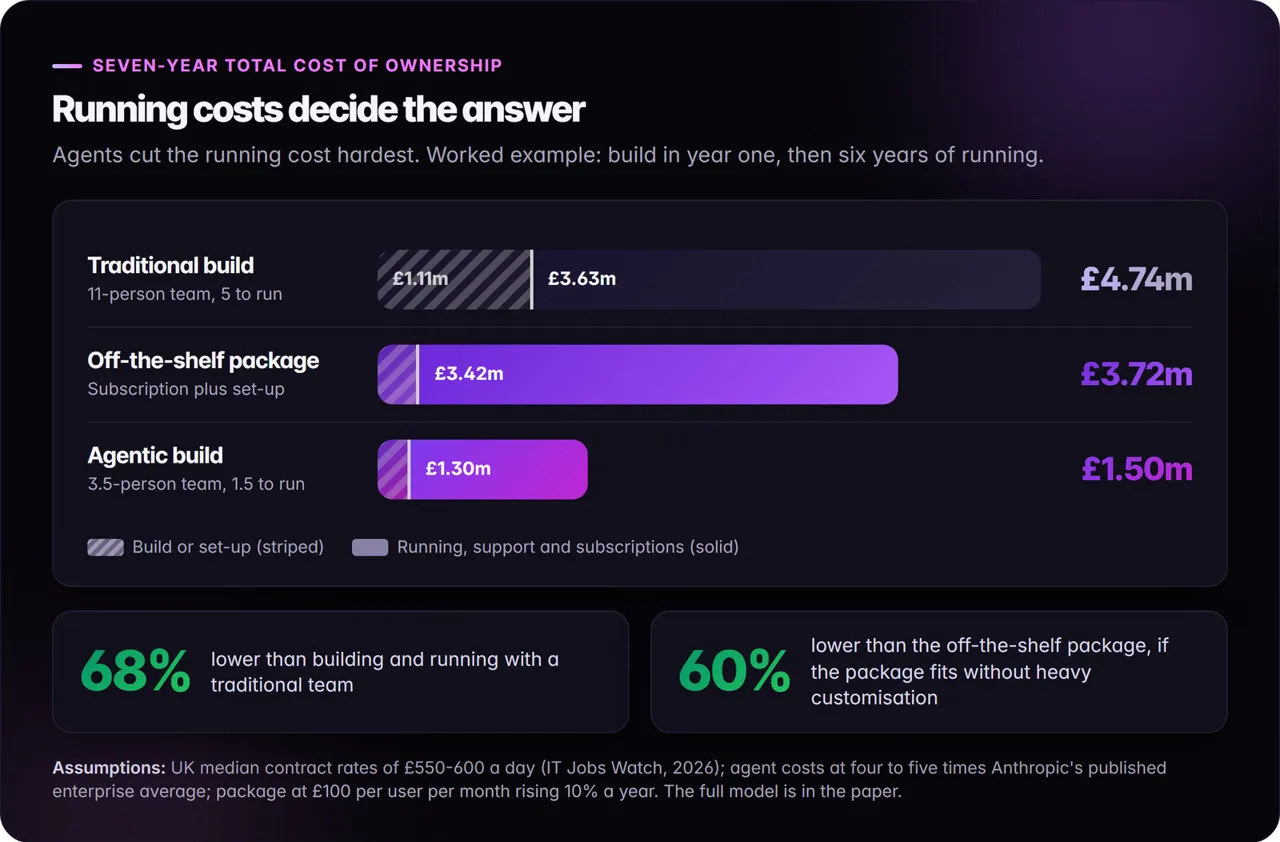
We modelled one mid-sized business application three ways. On published UK day rates, the traditional build and run comes to about £4.74m over seven years, a subscription package about £3.7m, and an agentic build about £1.50m. Even with agent and model costs at four to five times Anthropic's published enterprise average, they are about 8% of the agentic total. The economics are driven by the size of the human team, not the token bill.
68%
lower seven-year cost than a traditional build, in our worked example
Buying has quietly got dearer
At the same time the other side of the scales has moved. Vertice recorded SaaS price inflation at a record 16.4% year on year in June 2026. AI features arrive as paid add-ons, and licences sized for a peak headcount rarely shrink.
The most expensive option of all is often the one that looks like a compromise: buying a package and customising it until it fits. Gartner research found ERP upgrades could cost up to 30% of the original implementation, and that some businesses spent ten times their licence fee on customisations.
This is not a case for building everything
Nobody should build their own general ledger or payroll engine, however cheap the code. And the evidence on AI tools is uneven: a 2025 controlled trial by METR found experienced developers were 19% slower with early-2025 tools in large codebases they knew well, while believing they were faster. Google's DORA research found AI raises delivery speed and instability together.
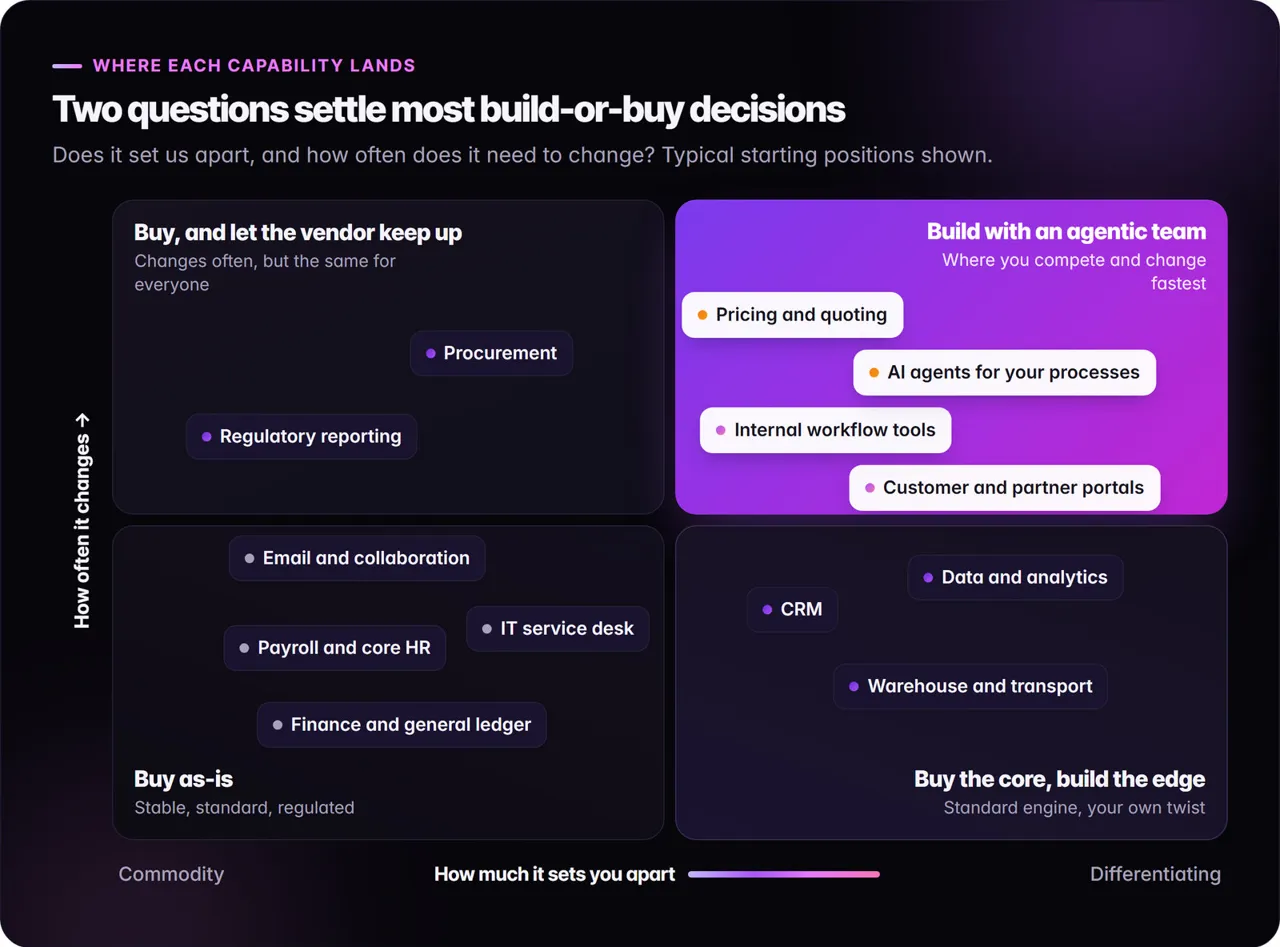
The answer depends on two questions: how much the capability sets you apart, and how often it needs to change. Stable, standard systems stay bought. Fast-changing work where you compete is where a small agentic team now earns its keep.
What is in the whitepaper
The full paper turns this into a decision you can make on Monday: the five options from buying as-is to building with an agentic team, a six-question framework, typical starting positions for common enterprise capabilities, the complete seven-year model with its assumptions, the risks and how to manage them, and a readiness checklist for a first agentic build.
It is free, 19 pages, and takes about 20 minutes to read. Get your copy.
Questions directors ask
Does this mean we should stop buying software?
No. Buy the systems nobody competes on, such as finance, payroll and email, and keep them clean. The shift is in the software around them, where you compete and where change is frequent.
Is the 68% figure a forecast?
No. It comes from a worked example on published UK contract rates and vendor cost data, with team sizes and durations as stated assumptions. The paper shows the full model so you can replace the figures with your own.
What do we need before building with AI agents?
An accountable product owner, a senior engineer who reviews every change, written specifications, automated tests and security scanning in the pipeline, and clean interfaces to the systems you buy. The paper's readiness checklist covers ten points.